


5 Signs Your Business Has Hit a Growth Ceiling — And Doesn’t Know It

Somewhere between the excitement of your first real revenue milestones and the comfort of a steady client base, something quietly changes. Growth doesn't usually crash. It just stops. Not because the market shifted or a competitor undercut you, but because the business itself has reached the edge of what its current structure can support.
In my work auditing businesses across industries, this is one of the most common patterns I see — and one of the hardest for owners to recognize on their own. A growth ceiling rarely looks like failure. It looks like busyness. Revenue holds steady, the calendar stays full, and everyone is working hard, so surely things are fine. They aren't. Below are five signs that a business has hit its ceiling, even when the day-to-day still feels like progress.
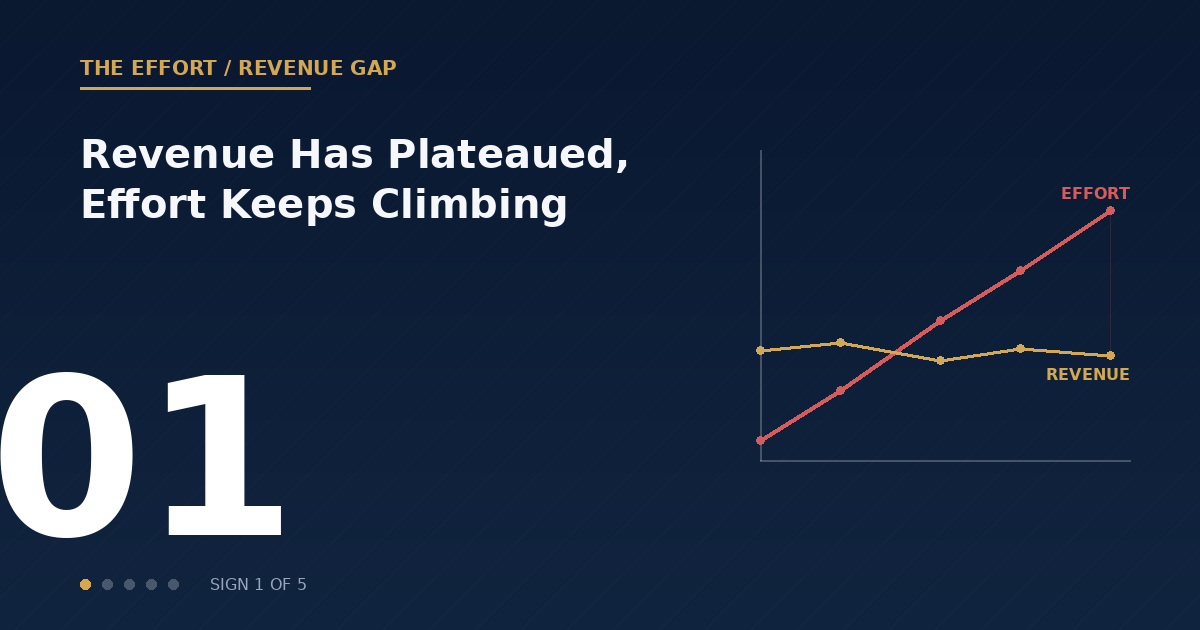
1. Revenue Has Plateaued, But Effort Keeps Climbing
The clearest sign of a growth ceiling is a widening gap between input and output. You're working longer hours, your team has grown, you've added services or products — and yet revenue has landed in roughly the same range for two, three, or four quarters running.
This is not a motivation problem, and it's rarely a "push harder" problem either. It's a structural one. When effort keeps rising while results stay flat, it usually means the systems underneath the business — how leads come in, how they're converted, how work gets delivered — haven't been rebuilt to match the size the business has actually grown into. You're running a bigger business on infrastructure sized for a smaller one.
2. You're the Bottleneck for Every Key Decision
If every proposal, hire, campaign, or pricing change needs to pass through you before it moves forward, the business isn't really scaling — it's stretching around your personal bandwidth. That's a ceiling with your name on it.
Founder-dependency feels responsible in the early years. It becomes the single biggest constraint on growth once the business has more than a handful of moving parts. A useful gut check: if you took two weeks fully offline, would revenue-generating activity continue without you making a single call? If the honest answer is no, the business has a growth ceiling built directly into its org chart.

3. Your Marketing Still Runs on the Same Playbook From Year One
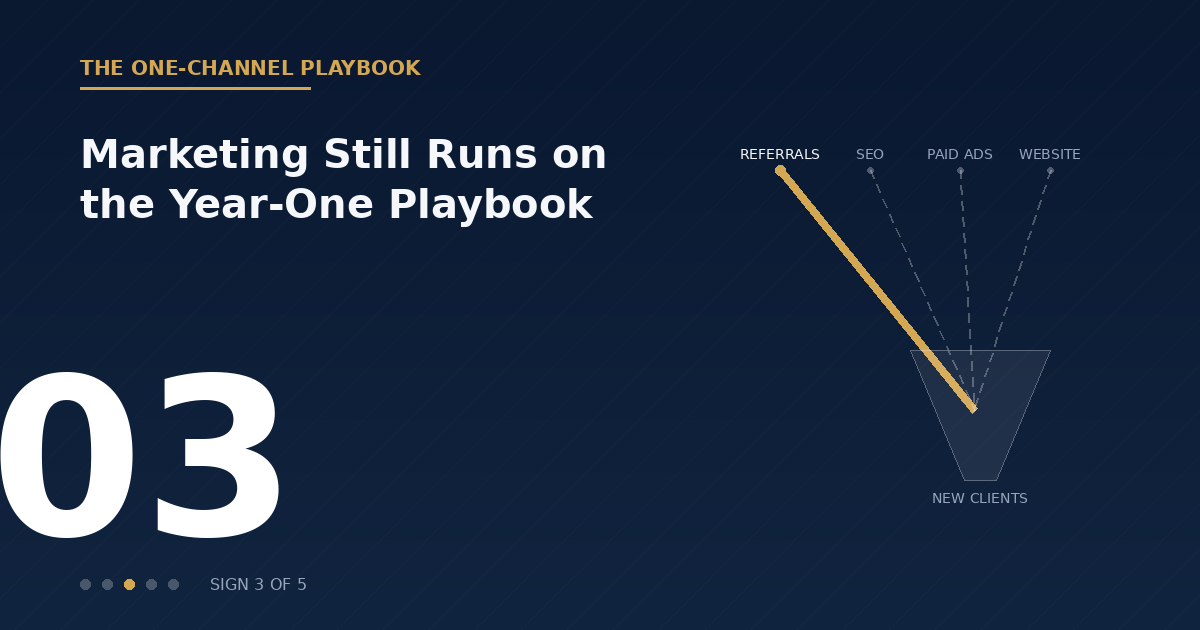
Referrals, word of mouth, and a personal network are how most businesses land their first clients — and there's nothing wrong with that. The problem shows up later, when those same channels are still the entire client acquisition strategy, with no repeatable system underneath them.
Referral-based growth is inherently capped: it scales with your existing relationships, not with market demand. If your business has no structured presence in search, no paid acquisition engine, and no consistent website performance driving inbound interest, you're not missing "nice-to-have" marketing. You're missing the mechanism that would let the business grow independently of who you already know. What got you to your first ceiling will not get you past it.
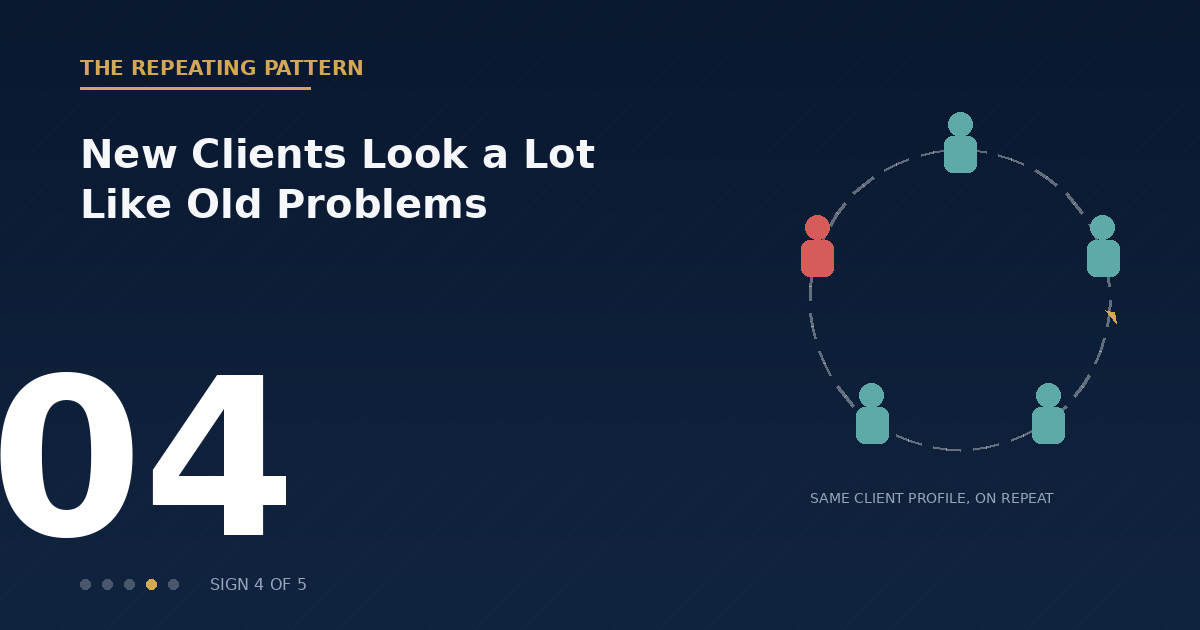
Take a hard look at the last five to ten clients or customers your business brought on. Are they a tighter fit for what you do best, at better margins, with fewer headaches — or do they look suspiciously similar to the ones you've been quietly complaining about for a year?
When a pipeline feels scarce, most owners say yes to whoever shows up next, regardless of fit. That instinct is understandable, and it's also how a growth ceiling gets reinforced rather than broken. Taking on poorly-matched clients out of fear of an empty pipeline erodes margin, consumes disproportionate time, and crowds out the capacity you'd need to serve better-fit clients well. Growth stalls not from a lack of new business, but from the wrong new business.
5. You Don't Actually Know Your Numbers
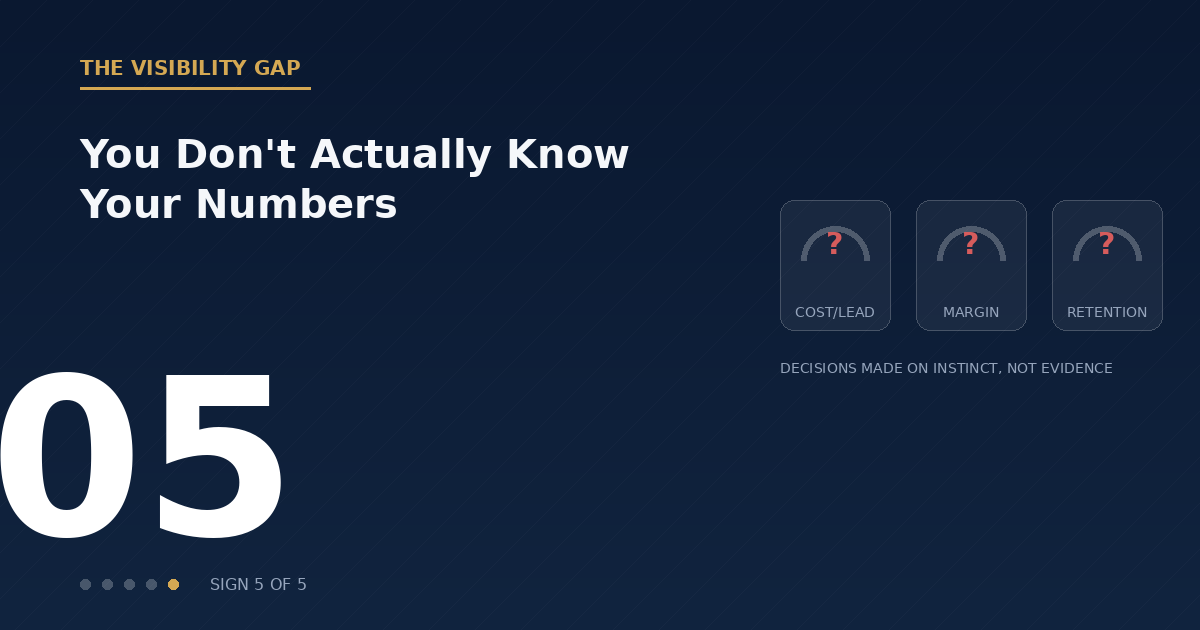
Ask a business owner who has hit a growth ceiling what their cost per lead is, or their margin by service line, or their client retention rate, and you'll often get a shrug, an estimate, or a number pulled from memory rather than from a system. That's not a bookkeeping gap — it's a visibility gap, and it's dangerous precisely because it's invisible.
Without clear numbers, every decision — what to invest in, what to cut, who to hire, which service to double down on — is made on instinct rather than evidence. Instinct works when a business is small enough to hold entirely in one person's head. Past a certain size, it becomes the reason resources keep going toward what feels productive instead of what actually is.
Why These Signs Get Missed
None of these five signs announce themselves loudly. Each one disguises itself as a normal, forgivable part of running a business: a "slow quarter," a "busy season," a team that "just needs a bit more structure eventually." Individually, each is easy to explain away. Together, they form a pattern that's very difficult to see from inside the business — precisely because the person looking is also the person who built every one of the systems in question.
This is the value an outside, structured audit provides that internal reflection usually can't: distance. Not more effort, not more hours, not more hustle — a clear-eyed look at where the actual constraint sits, backed by evidence rather than intuition.
Where to Go From Here
If two or more of these signs sound familiar, the business likely isn't short on effort or ambition. It's operating against a ceiling that was never intentionally designed — it simply formed as a side effect of getting this far. The good news is that ceilings built by circumstance can be identified and removed by design.
That's exactly what a structured growth audit is built to do: a clear-eyed look across your marketing, your systems, and your decision-making to pinpoint the specific constraint holding revenue flat — and a concrete plan to move past it. If you recognized your business in more than one of the signs above, that's the conversation worth having next.
