 Skip to navigation
Skip to main content


How to Build a Go-To-Market-Ready Platform for Your Business

Most businesses today do not have a shortage of digital tools. They have a website, a CRM, advertising accounts, analytics platforms, email software, social media channels and, increasingly, automation and AI tools. The problem is that these systems are often introduced at different stages of the company’s growth and for different reasons. The website was built first, the CRM came later, advertising was introduced when more leads were needed, and tracking was added when management started asking where those leads were coming from.
Individually, each decision may have made sense. Collectively, however, they can leave a business with a collection of digital tools rather than a functioning commercial system.
This becomes particularly obvious when the company decides to grow. Increasing an advertising budget is easy enough. Generating more traffic is possible. Producing more content is possible. The more important question is what happens after that attention has been generated. Does the website explain the offer properly? Are enquiries captured and followed up consistently? Does the sales team know where opportunities came from? Can management connect marketing spend with actual customers and revenue?
A go-to-market-ready platform is designed to answer those questions. It connects the website, acquisition channels, CRM, tracking, content, automation and sales process around the way the business actually acquires customers. It is less about having more technology and more about making the technology already in use work as one commercial environment.
Start With the Way Your Business Actually Sells
One of the easiest mistakes to make is building the technology before properly defining the customer journey. Businesses purchase software because it is popular, create landing pages because competitors have them and introduce automation because automation sounds efficient. A better starting point is understanding how a customer realistically moves from discovering the company to becoming a customer.
An e-commerce business selling relatively inexpensive products may have a short journey. Someone discovers a product, compares alternatives, checks reviews and makes a purchase. A B2B company selling a £30,000 service could have a buying process lasting several months and involving multiple people. A prospect may discover the company through Google, read an article, return weeks later, review a case study and only then request a consultation.
Those businesses should not have the same go-to-market architecture.
Before choosing technology, a company should understand who buys from it, what causes customers to start looking for a solution, what information they require before making contact and what happens once an enquiry enters the business. Once those questions have credible answers, decisions about websites, CRM systems, marketing channels and automation become considerably easier.
Instead of asking, “Which CRM should we buy?” the company can ask, “What information does our sales process actually need the CRM to preserve?” That small change in thinking often prevents a great deal of unnecessary complexity.
The Website Should Sit at the Centre of the Commercial Journey
For most businesses, the website will become one of the central parts of the go-to-market platform. Prospects may discover the company through Google, LinkedIn, advertising, email or recommendations, but many will eventually visit the website before making a serious decision.
The website therefore has to do more than look professional. It needs to explain the business clearly, support different stages of the buying process and provide evidence that gives potential customers confidence to continue. Depending on the company, that might mean service pages, case studies, technical information, testimonials, FAQs, project examples or detailed explanations of how the service is delivered.
This makes website architecture a commercial decision as much as a design decision. Advertising campaigns may need dedicated landing pages. Different industries may require different messages. International growth may eventually require multiple markets or languages. Tracking and CRM integrations need to work reliably behind the visible website.
The objective is not to build every feature the company could conceivably need in the future. It is to create a foundation flexible enough that normal business growth does not require rebuilding the entire digital operation every eighteen months.


Marketing Channels Should Work Together
Fragmentation becomes particularly expensive when businesses begin investing seriously in customer acquisition.
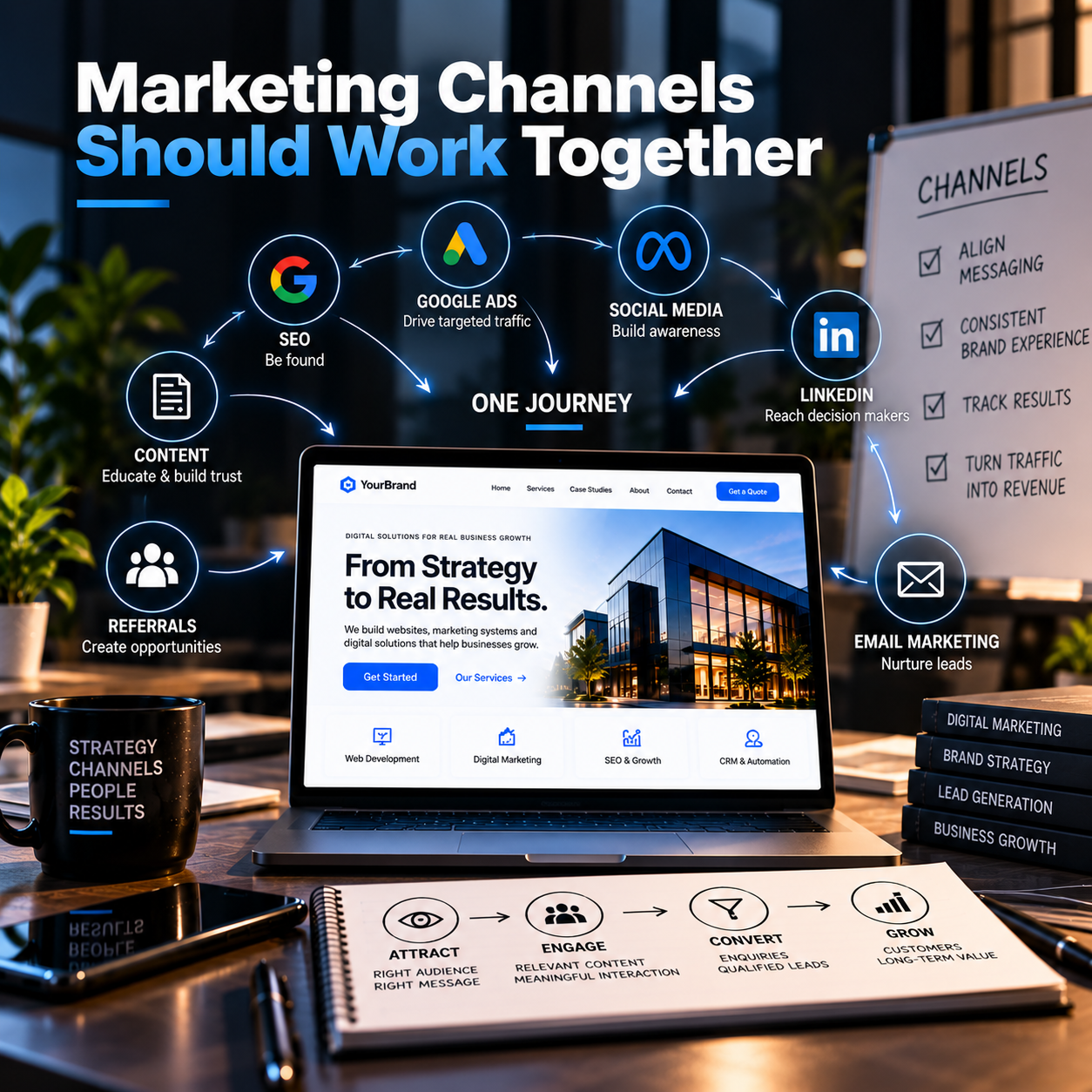
Google Ads may be managed by one person, SEO by another, social media by somebody else and the website by an external developer. Each team can produce a report showing activity within its own area, yet the customer does not experience the business in departments.
Someone might discover the company on LinkedIn, search for it on Google several days later, read an article, leave, return through an advertisement and eventually submit an enquiry after viewing a case study. Internally, several channels may want credit for that conversion. From the customer’s perspective, it was simply one relationship with one company.
A go-to-market-ready platform needs to create continuity between those interactions. An advertisement about a particular problem should lead to a page that continues the same conversation rather than dropping the visitor onto a generic homepage. SEO articles should connect naturally with relevant services. Email campaigns should lead to content that reflects the reason the recipient clicked.
Good marketing generates attention. The rest of the platform needs to make that attention commercially useful.
The CRM Should Become the Commercial Memory of the Business
There is a critical moment in the customer journey when an anonymous website visitor becomes a known prospect. They submit a form, request a quotation, book a consultation or otherwise identify themselves to the company.
What happens next determines whether the CRM becomes genuinely useful or simply another database.
A properly connected CRM should preserve the relationship between marketing and sales. The information submitted through the website can enter automatically, the original source can be recorded, an owner can be assigned and the opportunity can move through defined sales stages. Eventually, the business should be able to connect at least part of the original marketing activity with a commercial result.
This changes how marketing performance can be evaluated. A campaign producing 100 cheap leads is not necessarily better than one producing 30 more expensive leads. If the second campaign consistently generates stronger opportunities and more customers, the commercial picture looks very different.
Cost per click and cost per lead are useful indicators. Cost per qualified opportunity and customer acquisition cost are much closer to the questions management actually cares about.
Without a reliable connection between marketing and CRM data, that picture is extremely difficult to build.
Tracking Should Answer Business Questions
Digital marketing makes it possible to measure an enormous amount of activity, but having more data does not automatically mean understanding the business better.
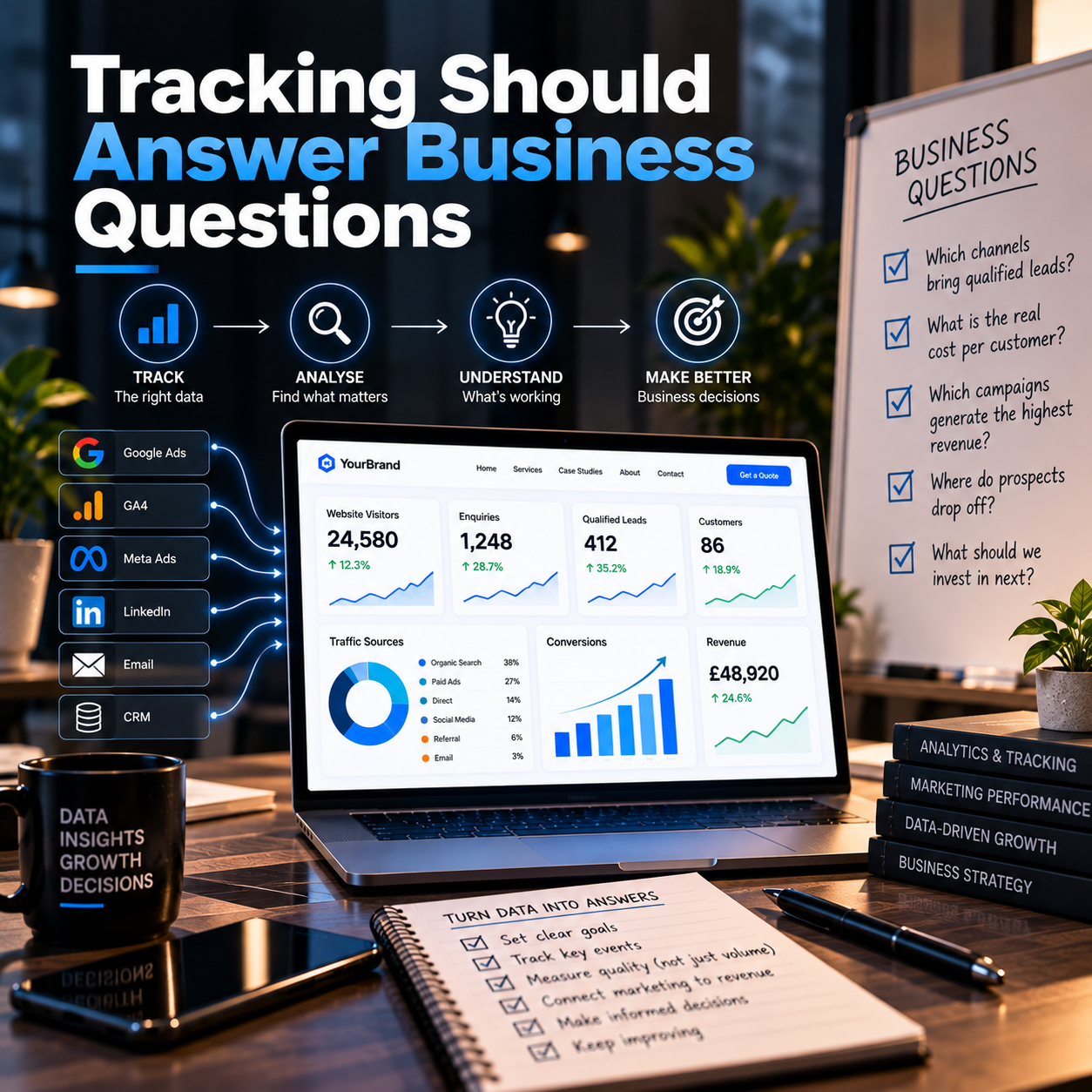
The starting point for tracking should therefore be surprisingly simple: what does the company genuinely need to know?
That may include which channels generate qualified enquiries, which landing pages convert effectively, which campaigns produce higher-value customers or where prospects abandon the journey. For e-commerce businesses, revenue and product-level behaviour may be central. For B2B organisations, booked meetings and qualified opportunities may matter considerably more than raw website traffic.
Analytics, conversion tracking, advertising platforms, CRM attribution and, where appropriate, server-side tracking can contribute to that picture. Consent management also needs to be integrated correctly so that measurement is implemented alongside the business’s privacy obligations rather than added as an afterthought.
The goal is not to track everything simply because it is technically possible. A good measurement system should help the company make decisions.
Management should be able to ask a reasonable commercial question about marketing and receive a reasonably reliable answer.
Content Should Support the Buying Process
Content can become disconnected from the commercial strategy surprisingly quickly. A company decides that SEO is important, starts publishing articles and eventually has a large blog that generates traffic but contributes relatively little to the actual sales process.
A stronger approach is to create content around the questions customers ask while making a decision.
Someone at the beginning of the journey may be researching a problem. Later, they may be comparing possible approaches. Closer to purchase, they may want evidence, implementation details, pricing guidance or reassurance that the company has solved similar problems before.
Different content can support each stage. Educational articles can create discovery. Service pages can explain the solution. Case studies provide evidence. Comparisons and guides help prospects evaluate options. FAQs can remove common objections before somebody needs to speak with sales.
This also makes content valuable beyond SEO. Sales teams can share useful articles with prospects, advertising campaigns can lead to more relevant information, and email campaigns can use existing resources rather than relying entirely on promotional messages.
Over time, the website becomes more than a company presentation. It becomes a useful commercial knowledge base.
Automation Should Make the Company Easier to Deal With
Once the underlying processes are clear, automation can remove a considerable amount of unnecessary administrative work. A website enquiry can enter the CRM automatically, the appropriate salesperson can be notified, a confirmation can be sent to the prospect and a follow-up task can be created if nothing happens within an agreed period.
Used properly, automation creates consistency.
Used badly, it makes the company feel mechanical.
Not every customer interaction should become an automated workflow. A prospect considering a significant investment may appreciate an immediate confirmation and some useful introductory information, but they are unlikely to appreciate weeks of generic automated emails pretending to be personal.
The best automation often happens quietly in the background. It moves information between systems, creates reminders, keeps records accurate and prevents opportunities from disappearing because somebody forgot to update a spreadsheet.
Technology should make the company more responsive without removing the human judgement that makes important commercial relationships work.

Marketing and Sales Need to Meet Somewhere
Generating more leads will not solve a weak sales process.
A company can optimise advertising campaigns extensively while enquiries continue sitting unanswered for days. Marketing can improve landing pages while the sales team keeps its own spreadsheets. Management can ask for more leads without anybody agreeing on what actually constitutes a qualified opportunity.
Before scaling acquisition, businesses should define what happens after an enquiry arrives. Who owns it? How quickly should somebody respond? What information needs to be collected? When does a lead become a genuine opportunity? What happens when a prospect does not respond?
The process does not need to be complicated. It simply needs to be consistent.
A connected platform supports that consistency. Leads can be assigned automatically, activities can be recorded and opportunities can be followed through the pipeline. The technology does not replace sales discipline, but it gives the business a much clearer view of what happens after marketing has done its job.
Build Privacy and Security Into the Platform
As the platform becomes more connected, more customer information moves through it. Website forms, advertising platforms, analytics systems, CRM software, email marketing and payment providers can all become part of the same digital environment.
That creates responsibilities.
Businesses should understand what information they collect, why it is needed, where it is sent and how it is protected. Privacy and consent requirements vary by jurisdiction and should be handled with appropriate legal and technical guidance, but from a platform perspective the principle is straightforward: these requirements should be considered during implementation, not added at the end.
Security belongs in the same conversation. Access management, backups, software updates, authentication and appropriate hosting become increasingly important when the website and connected systems are responsible for generating and processing commercial opportunities.
A platform designed to support growth also needs to be designed to protect what that growth creates.
The Platform Should Improve After Launch
A go-to-market platform should never be treated as completely finished.
The market will provide information that no planning process can fully predict. Customers will respond differently to certain messages. Some landing pages will perform better than expected. Sales teams will repeatedly hear questions that the website does not answer. Certain marketing channels may generate large numbers of enquiries but few serious opportunities.
The important thing is whether the business can see those signals and respond to them.
Marketing data shows what attracts attention. Website behaviour shows what people explore. CRM data shows which enquiries become opportunities. Sales conversations provide context that analytics cannot. Revenue eventually shows which activities are creating actual commercial value.
Those insights should feed back into the platform. If prospects repeatedly ask the same question, the website may need to answer it more clearly. If one case study consistently helps sales conversations, the business may need more content like it. If a campaign generates traffic but poor enquiries, the problem may lie in the offer or positioning rather than the advertising itself.
This is where a connected platform becomes much more valuable than a collection of digital services. It gives the company a feedback loop between what it does in the market and what the market does in response.
The Real Advantage Is Less Fragmentation
A mature go-to-market operation may eventually contain a significant amount of technology, but the number of tools is not what makes it mature.
The advantage comes from connection.
The advertisement and landing page should tell the same story. The website should collect information the sales team actually needs. The CRM should preserve enough context to understand where opportunities came from. Tracking should provide useful commercial information. Content should support both discovery and decision-making. Automation should remove repetitive work without damaging the customer experience.
When those elements work together, the business becomes easier to understand from the outside and easier to operate from the inside.
That is ultimately what a go-to-market-ready platform should achieve. It is the infrastructure between the company’s strategy and its customers: the system that helps turn attention into interest, interest into opportunity and opportunity into commercial value.
For a growing business, that foundation becomes increasingly important. Processes that work with ten enquiries a month may struggle with one hundred. Informal communication becomes harder as teams expand. Marketing budgets become more difficult to justify when attribution is unclear, and opportunities begin falling between systems that were never designed to work together.
A strong go-to-market platform does not guarantee growth. What it does is give the business a better structure for pursuing it, measuring it and improving it.
