 Skip to navigation
Skip to main content


A website is often treated as a marketing asset. It is where a company presents its services, publishes content, generates leads or sells products. For many businesses, however, the website has quietly become something much more important than that.
It is connected to advertising platforms, analytics tools, CRM systems, payment providers, email marketing software, customer databases and internal processes. Leads pass through it. Customers create accounts on it. Transactions may depend on it. Search engines evaluate it, advertising campaigns send traffic to it, and prospective customers often use it as their first opportunity to decide whether a company appears credible.
That makes website security a business issue, not simply a technical one.
The consequences of a compromised website are rarely limited to “the website was hacked.” A security incident can interrupt sales, expose information, damage search visibility, redirect customers to malicious pages, affect advertising campaigns and leave a company trying to understand what happened while its digital operation is partially or completely unavailable.
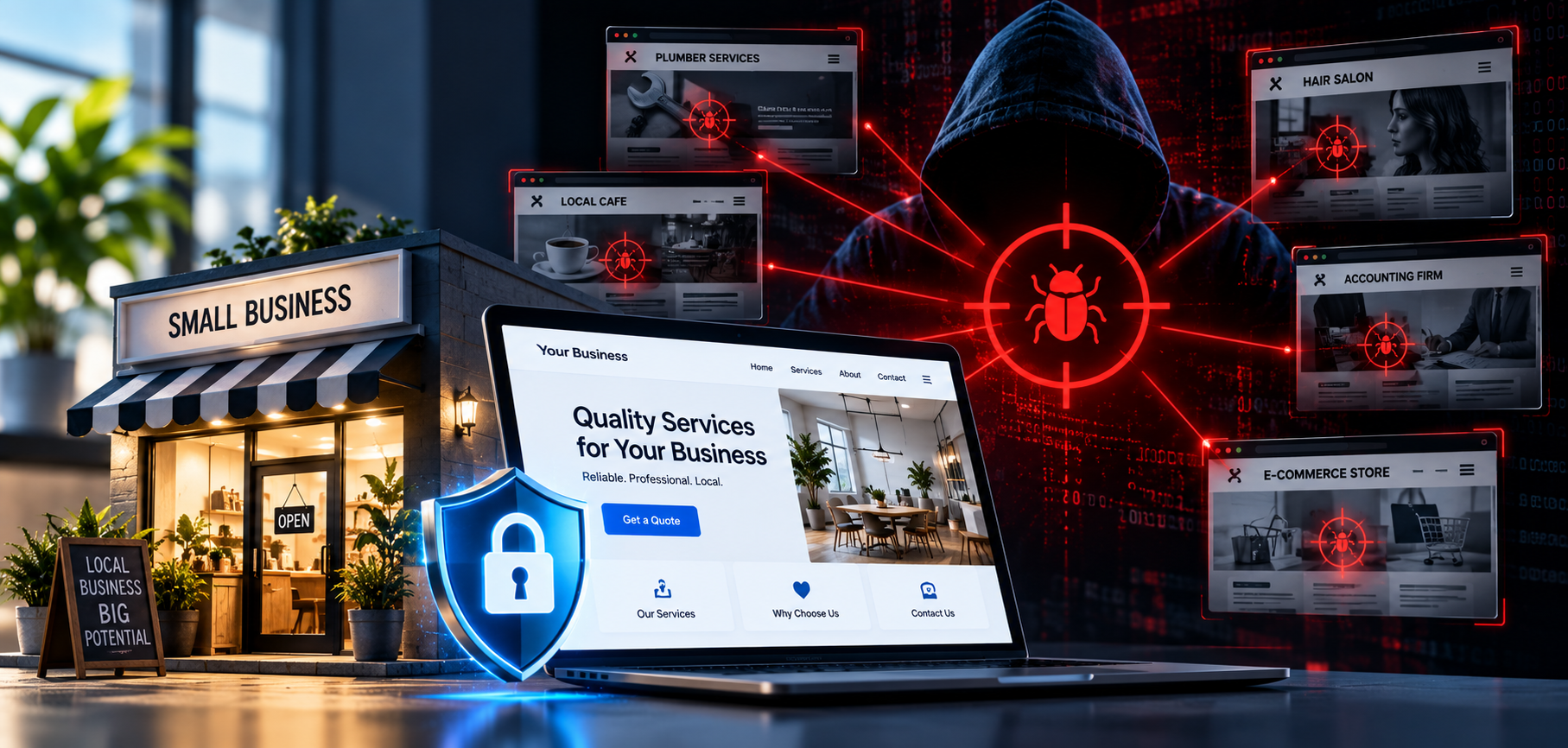
For smaller businesses in particular, the assumption that cybercriminals are only interested in large organisations can create a dangerous sense of security. Attackers do not necessarily choose websites because the company behind them is famous or particularly valuable. Much of malicious activity on the web is automated. Systems continuously scan websites looking for outdated software, weak credentials, vulnerable plugins, exposed administration areas and other opportunities.
The website does not have to be important to the attacker.
It only has to be vulnerable.
A Website Is Part of Your Business Infrastructure
The way businesses use websites has changed significantly.
A traditional company website might once have consisted of a few static pages containing contact details and information about the organisation. If that website stopped working for several hours, the inconvenience was relatively contained.
Modern websites are different.
A service company may rely on its website for lead generation. An e-commerce company may generate most of its revenue through it. A recruitment business may collect candidate information through forms. A hotel or restaurant may depend on booking integrations. A professional services company may connect website enquiries directly to its CRM and sales automation.
Even relatively simple websites usually communicate with several external systems.
When the website becomes compromised, those connections increase the potential impact.
This is why web security should be considered part of operational risk management. Protecting the website is not just about protecting files on a server. It is about protecting a system that other parts of the business increasingly depend upon.

“Our Website Is Too Small to Be Targeted” Is Not a Security Strategy
One of the most persistent misconceptions around website security is that smaller businesses are unlikely to attract attention.
This assumes that somebody has to personally select the company as a target.
That is often not how attacks work.
Automated tools can scan enormous numbers of websites searching for known vulnerabilities. If a particular version of a plugin, CMS, theme or server component contains an exploitable weakness, attackers can look for websites running that software at scale.
Weak passwords can also be attacked automatically. Login pages can be subjected to repeated authentication attempts. Vulnerable forms can be tested for weaknesses. Exposed services can be scanned without anybody knowing or caring which business owns the domain.
From the attacker's perspective, the process can be opportunistic.
A small business website running outdated software may therefore be more attractive than a much larger website protected by a competent security programme.
Size does not provide security.
Good security practices do.
What Actually Happens When a Website Is Compromised?
The popular image of a hacked website is a homepage replaced with an obvious message from the attacker.
That certainly happens, but many compromises are far less visible.
In some cases, an attacker has little interest in announcing their presence. The website may continue to look completely normal to the business owner while malicious code operates underneath it.
A compromised site might redirect selected visitors to fraudulent pages, inject spam content, create hidden pages, distribute malware, send unwanted email or provide attackers with continued access to the server.
E-commerce environments create additional risks because customer accounts, orders and payment-related systems may be involved.
The commercial problem is that the business may not immediately know what has changed.
A website can appear operational while something harmful is happening in the background.
This is one reason regular monitoring matters. Security cannot depend entirely on somebody noticing that the homepage suddenly looks different.
Security and Customer Trust Are Closely Connected
Trust is difficult to build online and remarkably easy to damage.
Customers have become accustomed to looking for signs that a website is legitimate. Browsers warning about insecure connections, unexpected redirects, suspicious pop-ups, broken pages or unusual checkout behaviour immediately create doubt.
Even if the underlying issue is resolved quickly, the experience can change how customers perceive the company.
Imagine arriving on a website after clicking an advertisement and being redirected somewhere suspicious. From the customer's perspective, the distinction between “the company was compromised” and “the company itself is untrustworthy” may not be particularly clear.
They simply leave.
For businesses that invest heavily in brand development, advertising and customer acquisition, allowing basic security failures to undermine that investment makes little commercial sense.
Website security is therefore part of brand protection.
Customers may never congratulate a business for maintaining a secure website. They expect it.
They notice when it is not.
SSL Is Important, but SSL Does Not Mean Your Website Is Secure
There is still considerable confusion around SSL certificates.
HTTPS encrypts information travelling between the visitor's browser and the web server. That encryption is essential, particularly when users submit forms, log into accounts or enter sensitive information.
Every serious business website should use HTTPS.
But an SSL certificate does not make the website itself secure.
It does not automatically protect an outdated WordPress plugin. It does not prevent an administrator from using a weak password. It does not remove malware already present on the server, and it does not replace backups, access controls, monitoring or software updates.
A compromised website can still have a perfectly valid SSL certificate.
HTTPS should therefore be understood as one layer of website security rather than proof that the entire environment is protected.
That distinction matters because good security is almost always layered.
WordPress Security Is Mostly About How WordPress Is Managed
WordPress deserves particular attention because of its enormous ecosystem.
Its flexibility allows businesses to extend a website with plugins, themes, e-commerce functionality, integrations and custom development. The same flexibility also means that the quality of a WordPress environment depends heavily on how those components are selected and maintained.
WordPress itself should be kept updated. So should themes and plugins. Unused software should generally be removed rather than left sitting on the installation indefinitely. Administrative accounts should be limited to people who genuinely require them, and passwords should be strong and unique.
Plugins require particular discipline.
Installing a plugin is easy, which sometimes creates the impression that every website requirement should be solved by adding another one. Over several years, a website can accumulate software that nobody actively uses, nobody understands and nobody is responsible for maintaining.
That is not simply a performance problem. It increases the website's attack surface.
A professionally managed WordPress website should therefore have a reason for every major component installed on it.
Security improves when unnecessary complexity is removed.
Passwords Are Still One of the Simplest Places to Improve Security
Businesses can invest in sophisticated security tools and still undermine them with poor account management.
Shared administrator accounts, reused passwords and credentials passed between employees through unsecured channels remain avoidable risks.
A better approach is relatively straightforward.
Each person who requires access should have an individual account with the minimum permissions necessary for their role. Strong, unique passwords should be used, ideally through a password manager, and multi-factor authentication should be enabled wherever practical.
Access should also be reviewed when circumstances change.
If an employee leaves the company, their website access should not remain active indefinitely. The same applies to freelancers, agencies and developers who were given temporary access for a particular project.
This is basic operational hygiene, but basic controls are often where security succeeds or fails.
Backups Are Not Optional
There is a significant difference between protecting a website and being able to recover one.
No security system can guarantee that an incident will never occur. Software vulnerabilities are discovered, human mistakes happen, infrastructure fails and updates occasionally cause unexpected problems.
This makes website backups one of the most important parts of a security strategy.
A useful backup should be automatic, frequent enough for the business and stored somewhere that will not disappear if the main hosting environment is compromised.
More importantly, it needs to be restorable.
A backup that has never been tested is partly an assumption.
For a simple brochure website that changes twice a month, the appropriate backup schedule may be relatively relaxed. For an online shop processing orders throughout the day, losing twenty-four hours of database activity could mean losing orders, account changes and operational data.
Backup strategy should therefore reflect the value and frequency of the data being generated.
Website Security Can Affect SEO
Security and SEO are often managed as completely separate disciplines, but they can intersect very quickly.
If attackers inject spam pages into a website, alter existing content or create malicious redirects, search engines may begin discovering URLs that the business never intended to publish.
A compromised website can therefore create indexation problems, damage user experience and potentially trigger security warnings.
Even after the original vulnerability has been fixed, cleaning up the consequences may require additional work. Malicious pages can remain indexed. Redirects may need investigation. Search platforms may need to be checked, and the website may require a broader technical review to make sure the compromise has actually been removed.
Companies investing consistently in SEO should therefore see security as part of protecting that investment.
Months or years of building organic visibility should not be placed at unnecessary risk because nobody was responsible for maintaining the website.
Advertising Can Be Affected Too
The same principle applies to paid advertising.
Businesses can spend thousands or tens of thousands every month driving visitors to landing pages. If those pages become compromised, redirect incorrectly or begin behaving suspiciously, the advertising operation can be affected alongside the website itself.
At that point, the cost of the incident is no longer limited to repairing the site.
There may be lost leads, wasted advertising spend, interrupted campaigns and internal time spent identifying the problem.
This illustrates why calculating the cost of website security purely in terms of hosting or maintenance fees is misleading.
The more valuable the traffic arriving at a website becomes, the more valuable protecting its destination becomes as well.
Security Is a Process, Not a Product
There is a tendency in digital services to search for one tool that solves an entire category of problems.
Website security does not work particularly well that way.
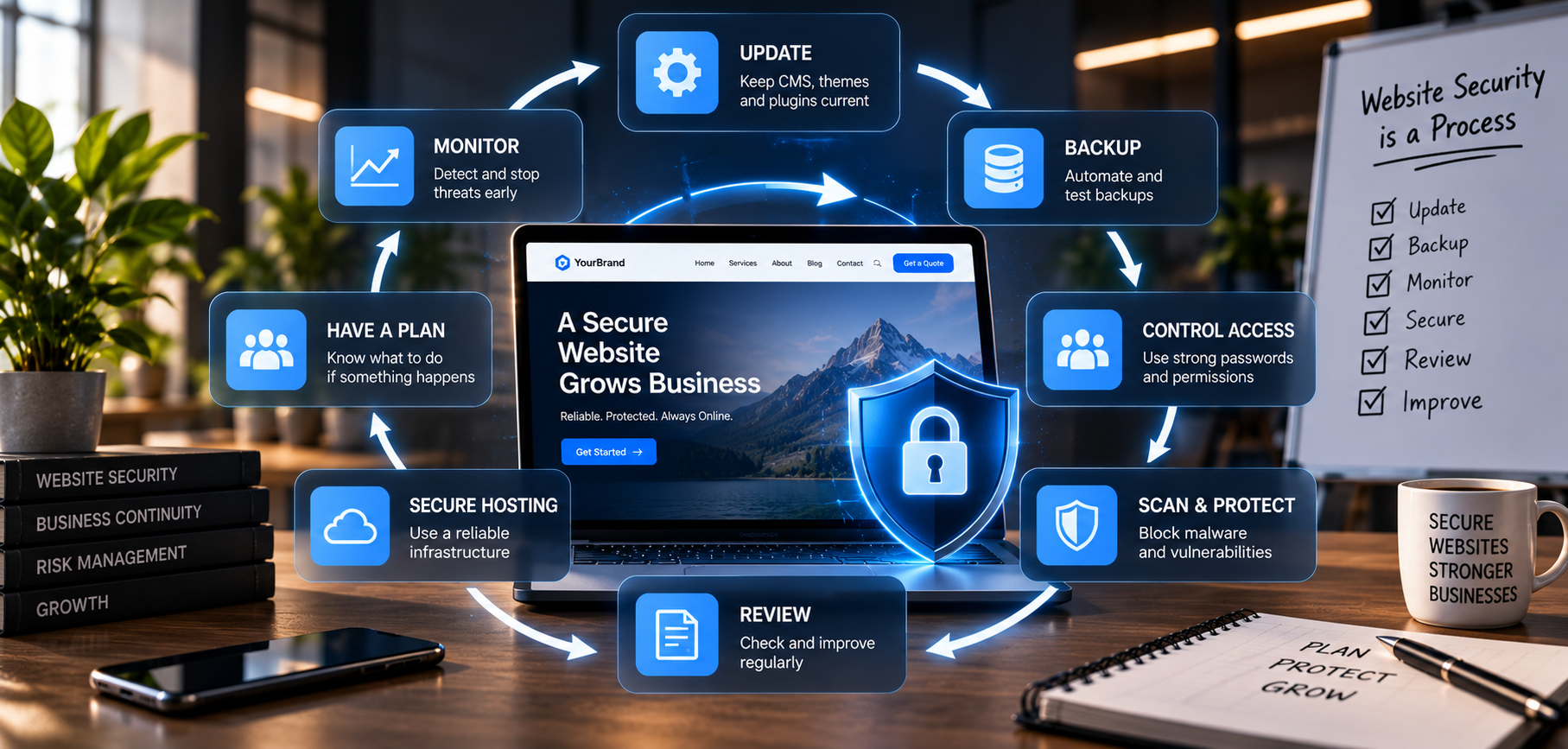
A firewall can be useful. Malware scanning can be useful. Security plugins can be useful. Strong hosting infrastructure matters. SSL matters. Backups matter.
None of them individually represents a complete security strategy.
A more realistic approach is layered.
The CMS and extensions should be maintained. Access should be controlled. Authentication should be strengthened. Backups should be automated. The website should be monitored. Hosting should be appropriate for the project, and somebody should know what happens if an incident is detected.
The final point is often overlooked.
Who receives the alert?
Who has access to the hosting environment?
Who knows where the latest clean backup is?
Who can restore the website?
Who checks whether customer data may have been affected?
Security becomes much easier to manage when those questions have answers before something goes wrong.
The Cost of Prevention and the Cost of Recovery Are Very Different Conversations
Website maintenance sometimes feels like an expense because, when it works properly, nothing dramatic happens.
Updates are installed. Backups run. Security monitoring remains quiet. The website continues operating.
There is no exciting result to show at the end of the month.
But compare that with the alternative.
When a website is seriously compromised, the business may suddenly require emergency development work, malware removal, server investigation, password resets, restoration from backups, SEO cleanup and coordination with hosting providers or other technology partners.
Meanwhile, enquiries or sales may be interrupted.
The cost is not only financial. Internal teams lose time dealing with a problem that was never part of their planned work.
This is why security should not be evaluated solely by asking, “How much does protection cost?”
The more useful question is:
What would it cost the business if this website stopped being trustworthy tomorrow?
For some companies, the answer may be relatively small.
For others, it could be substantial.
A Secure Website Is Part of a Professional Digital Operation
There is no such thing as a completely risk-free website.
That is not a reason to ignore security. It is the reason to approach it properly.
A business does not need to become a cybersecurity company to operate a website responsibly. It needs sensible controls, maintained software, reliable backups, appropriate access management, competent hosting and people who understand what they are responsible for.
As the website becomes more important to marketing, sales and operations, those responsibilities should become more mature with it.
Businesses routinely invest in redesigns, SEO, Google Ads, Meta Ads, content, analytics and conversion optimisation because they want more people to visit their websites and take action.
Protecting the environment all of that activity depends on should be part of the same conversation.
Website security is not particularly glamorous. When it is managed well, most customers will never notice it.
That is exactly the point.
The website stays online. Forms continue working. Customers can trust the connection. Advertising reaches the destination it was supposed to reach. Search engines see the pages the business intended to publish, and the company retains control of one of its most important digital assets.
Good web security rarely attracts attention.
Poor web security eventually does.


